
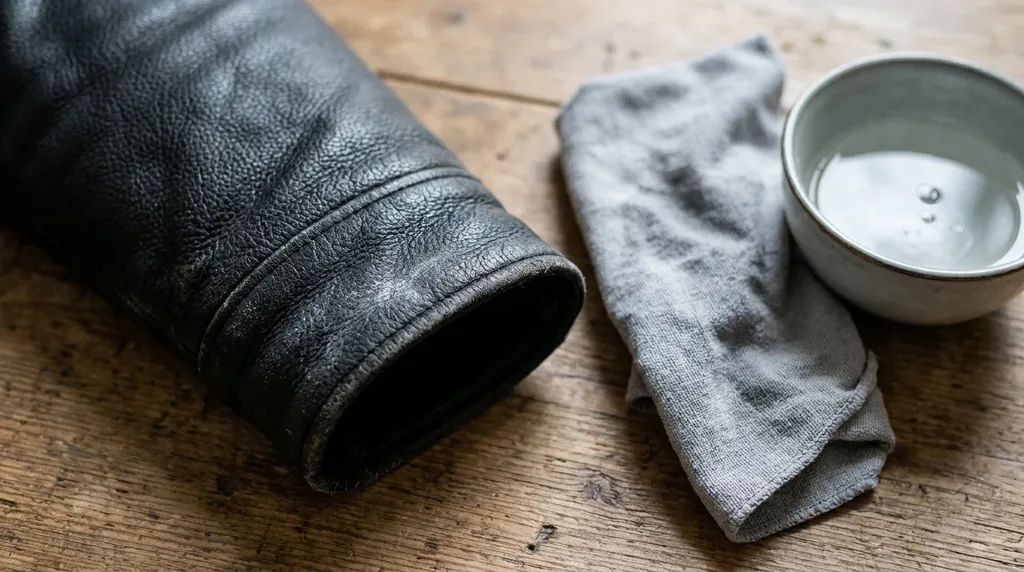
Winter roads leave a mark on more than your car. After a few walks in slush, a leather jacket can end up with white, crusty lines on the cuffs, the hem and the sleeves. Those marks are salt, and they will not fade by themselves. The good news is that you can usually fix them at home, if you are gentle. Here is how to remove salt stains from a leather jacket.
Table of Contents

Why Salt Leaves White Marks
Road salt dissolves in slush and splashes onto your clothes. When the water dries, the salt stays behind and forms a white line or a crust on the surface. Salt also pulls moisture out of leather, so if you leave it there it can leave the spot dry and stiff. Fixing it early is easier than waiting until the end of winter.
Step One: Let It Dry and Brush Off the Crust
If the jacket is wet, let it dry naturally at room temperature, away from radiators and hair dryers. Heat can make leather stiff and cracked. Once it is dry, gently brush off any loose salt with a soft dry cloth. Do not rub hard, because the crystals can scratch the surface.
Step Two: Wipe With Vinegar and Water
Mix equal parts white vinegar and water. Dip a soft cloth in the mix, wring it out well so that it is only damp, and wipe the salt line gently. Repeat on a clean part of the cloth until the white mark is gone. This is the same method that One Good Thing by Jillee uses for salt on leather boots. Work across the whole panel so that you do not leave a new ring.
Step Three: Wipe Again and Let It Dry
Go over the area with a second cloth that is barely damp with plain water to lift off the vinegar. Then let the jacket dry naturally, on a wide hanger, away from heat. Do not use a hair dryer to speed it up.
Step Four: Condition the Leather
Vinegar can draw some moisture out of leather, so finish with a good leather conditioner. Apply a small amount with a soft cloth, work it in gently and wipe off the extra. Our guide on how to care for a leather jacket explains conditioning in more detail.
Test a Hidden Spot First
Leather comes in many finishes, and they do not all react the same way. Before you use vinegar on a visible area, test it on a hidden spot, like the inside of the hem. Wait until it dries and check that the color has not changed. If it looks fine, go ahead.
Suede and Nubuck Need Care
This method is for smooth leather. Suede and nubuck are more delicate, and water can mark them. Check the care label, use a product made for suede, or ask a leather specialist. Our guide on how to remove stains from a leather jacket covers other kinds of marks.
How to Prevent Salt Stains
The best fix is to avoid the problem. After you walk through slush, wipe the cuffs and the hem with a soft, barely damp cloth, and hang the jacket to dry. A protector spray made for leather can help the leather resist water and salt, and you should test it first on a hidden spot. Read our guides on a leather jacket in winter and on a leather jacket in the rain for more on wet weather.
When to Call a Professional
If the salt has been there all winter, if the leather feels dry and cracked, or if the jacket is suede, a leather specialist is the safer choice. It costs less than replacing the jacket. Store the jacket in a cool, dry place when winter ends, as shown in our guide on how to store a leather jacket.
Quick Questions
What removes salt stains from leather?
A cloth that is barely damp with a mix of equal parts white vinegar and water usually works on smooth leather. Condition the leather afterward.
Can I use a hair dryer to dry the jacket?
No. Heat can make leather stiff and cracked. Let it dry naturally on a wide hanger.
Does this work on suede?
No. Suede and nubuck are more delicate, so use a suede product or ask a specialist.
Leave a Reply