Shop for a leather jacket for a few minutes and you will see the same words again and again: full grain, top grain, genuine leather. They sound like a quality ladder, but the real picture is a bit messier. Here is what each term means, how they wear, and what to ask before you buy.
Table of Contents

The Short Answer
Full grain is leather where the whole grain layer is left in place and the surface has not been sanded away. Top grain is used in a few different ways, but in shops it usually means the surface has been sanded or buffed to some degree for a more even look. Genuine leather is real leather, but the phrase does not name a grade. None of these labels tells you how a jacket will feel, so use them as a starting point and not a verdict.
What Full Grain Means
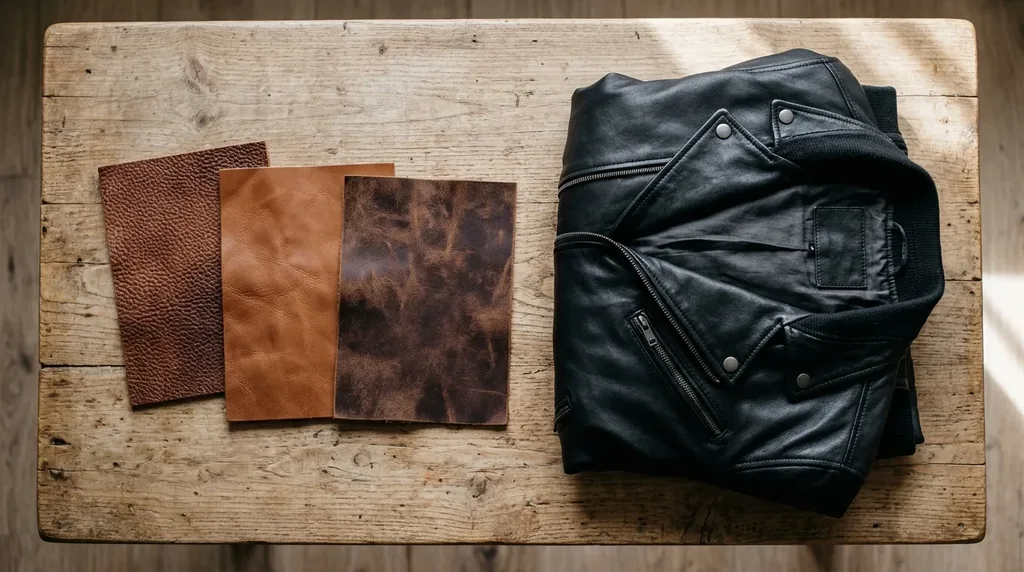
Leather comes from the outer layer of a hide, called the grain, and from the layers underneath. The Wikipedia page on leather describes full grain as leather that contains the entire grain layer, without any removal of the surface. Because nothing is sanded off, small natural marks such as scars or wrinkles can stay visible. Full grain is usually considered the highest quality, and it develops a patina as it ages instead of simply wearing out.
What Top Grain Means
This is the term that confuses people most. Technically, top grain means the grain layer is still there, and Wikipedia notes that full grain is one type of top grain. In everyday shopping the word is used more loosely. Sellers often use it for leather where the surface has been sanded or buffed to remove flaws and give a more uniform look. One leather industry resource, American Leather, even warns that the phrase can be a polite way of saying the leather is not full grain. So when you see it, ask what it means for that specific jacket.
What Corrected Grain Means
Corrected grain is leather where the surface has been buffed or sanded to take out flaws, then dyed and often embossed with an artificial grain pattern so it looks even. It gives a very uniform finish. It does not develop the same kind of patina that full grain does.
What Split Leather and Suede Are
When a thick hide is split into layers, the top becomes the grain layer and the layer underneath is called split. Suede is made from the underside of a split. Some split leather is coated with a plastic layer and embossed with a grain pattern, and Wikipedia calls that bicast leather. Split leather is usually less durable than the grain layer above it, so it is more common in budget pieces than in jackets meant to last.
What Genuine Leather Really Means
Genuine leather tells you the material is real leather and not a synthetic. According to Wikipedia, it does not describe a specific grade, and it often refers to heavily processed split leather. Rules for using the phrase also differ from one country to another. So genuine leather is not a warning sign on its own, but it is not a quality promise either. Our guide on how to tell if a leather jacket is genuine shows what to look for, and real vs faux leather explains the difference with synthetics.
The Grades at a Glance
| Term | What it usually means | What to expect |
|---|---|---|
| Full grain | The whole grain layer, surface not sanded away | Natural marks, develops a patina, usually seen as top quality |
| Top grain | Grain layer kept, often sanded or buffed in shops | More even look, term is used loosely |
| Corrected grain | Surface sanded, dyed and often embossed | Very uniform look, little patina |
| Split leather | The layer under the grain, or suede | Less durable, often found in cheaper items |
| Genuine leather | Real leather, no specific grade | Ask what the leather actually is |
Does Grade Matter for a Jacket
It matters, but it is only one part of the story. The animal matters too. Lambskin is soft, light and drapes well, while cowhide is heavier and tougher, and Wikipedia notes that lamb is often used for soft leather in more expensive clothing. Thickness, tanning, the finish and the lining all change how a jacket feels. Our guide on lambskin vs cowhide explains the two, and the lining guide covers the part you cannot see at first glance.
What to Ask Before You Buy
- What animal is the leather from, for example lambskin or cowhide?
- Is the surface natural, sanded, dyed or embossed?
- How thick is the leather, and how does it feel on the shoulders and sleeves?
- What is the lining made of?
- Can the seller answer questions about one specific jacket, not only the whole range?
If you are buying online, our guide on how to buy a leather jacket online has a longer checklist.
Asking Us About a Jacket
Every jacket we sell is made to order. If you want to know more about the leather in a specific style, send us a message before you order and we will reply by email, usually within a day. You can also read how made to order jackets work. Browse our leather bomber jackets or the biker leather jackets to see the range. Shipping is free worldwide.
Quick Questions
Is full grain better than top grain for a jacket?
Full grain is usually seen as the higher grade, and it develops a patina. But a jacket also depends on the animal, the thickness, the finish and the build, so judge the whole jacket.
Is top grain a quality rating?
Not really. Technically it means the grain layer is intact, and shops often use it loosely. Ask what it means for the jacket you are looking at.
Is genuine leather bad?
It is real leather, but the phrase does not name a grade. Ask what the leather is and how it was finished.
Does corrected grain still look good?
It can look very even and clean, but it does not develop the same patina as full grain.
Leave a Reply